
 HighVocab Team
Why flashcards work
When you look at a card and try to remember the answer before you flip it, you're practising active recall. Studies on the testing effect show that this strengthens memory much more than re-reading a list, even when your guess is wrong.
Add spacing — reviewing each card at growing intervals — and flashcards become one of the most efficient ways to learn vocabulary. Read more in our guide to spaced repetition.
What to put on a vocabulary flashcard
Front
The word: reluctant
Pronunciation: /rɪˈlʌktənt/
Example with the word hidden: She was ____ to leave early.
Back
Meaning: not wanting to do something
Pattern: reluctant to + verb
Translation (optional)
Full example sentence
The front should make you think. The back should give you everything you need to use the word: meaning, grammar pattern and a real example.
Card formats that work
| Format | Front | Back | Builds |
|---|---|---|---|
| Recognition | English word | Meaning | Reading and listening |
| Production | Meaning or translation | English word | Speaking and writing |
| Cloze (gap-fill) | Sentence with a gap | Missing word | Grammar and collocation |
| Audio | Hear the word | Spelling and meaning | Listening |
| Picture | Image | Word | Concrete nouns and verbs |
Start with recognition, then add production cards for the words you want to use actively. Production is harder, but it's what lets you say the word.
Common flashcard mistakes
- Too much on one card. If a word has three meanings, make three cards. Small cards are faster and easier to remember.
- Translation only. You'll know the meaning but not how to use the word. Add an example sentence.
- Flipping too fast. Always say your answer (out loud or in your head) before you flip.
- Lying to yourself. If you weren't sure, mark it as wrong. It's not a test, it's practice.
- Cramming. Reviewing 200 cards in one evening, then nothing for a week, is the least effective way to use flashcards.
- Random words. Cards from a list you'll never meet again are hard to remember. Words from your own reading stick much better.
Paper vs app flashcards
| Paper cards | Flashcard app | |
|---|---|---|
| Making cards | Slow — but writing helps memory | Fast; definitions and audio added for you |
| Scheduling | Manual (e.g. Leitner boxes) | Automatic spaced repetition |
| Pronunciation | You add IPA yourself | Audio built in |
| Carry anywhere | A stack in your bag | On your phone and computer |
| Best for | Small sets, young learners | Hundreds or thousands of words |
Paper works well for a small set of words. Once you have more than about 100, an app saves you hours of sorting and planning.
Flashcards in HighVocab
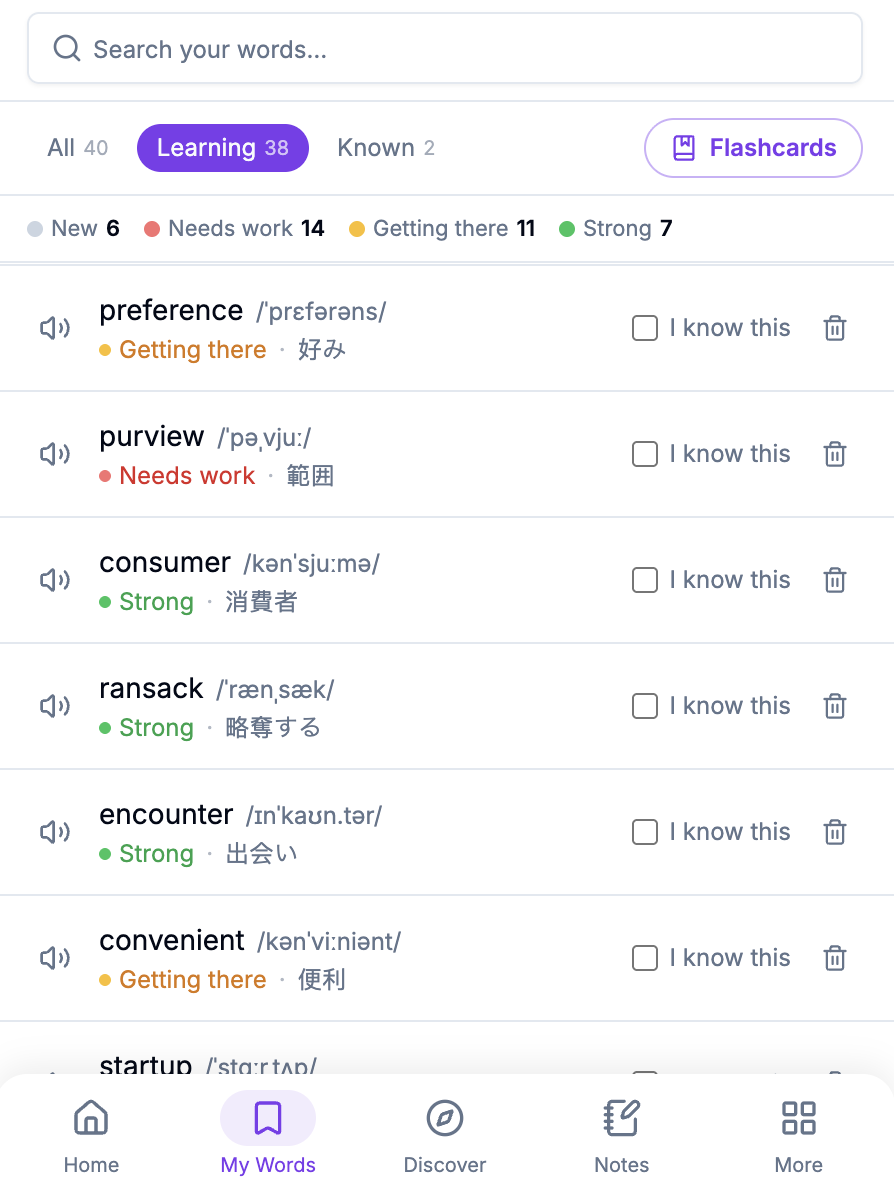
HighVocab turns every word you save into a flashcard automatically. Each card already includes a definition, example sentence, pronunciation and translation, so you never have to type one by hand.
- Flashcards: see the word, think of the meaning, flip, then tap Got it or Still learning.
- Quiz: read a definition and fill in the missing letters of the word.
- Automatic schedule: words come back after 1, 3, 7, 14 and 30 days. Get one wrong and it comes back today.
- Real-life review: the browser extension highlights your saved words on websites and in YouTube and Netflix subtitles between sessions.
How to review your flashcards
- Review every dayFive minutes daily beats an hour once a week.
- Do due cards firstStart with the most overdue cards — they're the ones you're about to forget.
- Answer before flippingSay the meaning or the word out loud.
- Add new cards slowly5–10 a day keeps your reviews manageable.
- Retire known wordsWhen a word is easy every time, mark it as memorized.
FAQ
Are flashcards good for learning vocabulary?
Yes. Flashcards use active recall, which is one of the most effective ways to remember information. They work best with spaced repetition and with example sentences, not just translations.
How many flashcards should I review a day?
It depends on how many words you're learning, but most learners do well with 5–10 new cards a day and 5–15 minutes of review. Keep it small enough that you can do it every day.
Should I put translations on my flashcards?
Translations are fine, especially at lower levels, but also add an English definition or example sentence so you learn how the word is used.
What is the best app for vocabulary flashcards?
It depends on your goal. General tools like Anki let you build any card. HighVocab is made for English words: it creates the flashcard for you when you save a word while reading, and schedules reviews automatically.
Flashcards that make themselves
Save a word anywhere online and HighVocab turns it into a flashcard with meaning, example and audio.
Also on Edge and Firefox. Free to start, no credit card.