
 HighVocab Team
What IPA is
The International Phonetic Alphabet is a set of symbols where each symbol stands for exactly one sound. It was created in the late 1800s so that any language could be written down the way it's actually spoken.
In English, the letters ough can be pronounced at least six different ways. In IPA, there's no guessing:
| Word | IPA | Listen |
|---|---|---|
| cough | /kɒf/ | |
| though | /ðəʊ/ | |
| through | /θruː/ | |
| tough | /tʌf/ |
How to read a dictionary entry
Take the word application: /ˌæplɪˈkeɪʃn/. Here's what each mark means:
| Mark | Meaning | Example |
|---|---|---|
| / … / | Slashes show the pronunciation. | /kæt/ = cat |
| ˈ | Main stress. The syllable after it is the loudest. | about /əˈbaʊt/ |
| ˌ | Secondary stress. A little stronger than unstressed syllables. | /ˌæplɪˈkeɪʃn/ |
| ː | Long vowel. Hold the sound a little longer. | see /siː/ |
| (r) | The r is pronounced in American English, and in British English only before a vowel. | car /kɑː(r)/ |
This guide uses the symbols found in most learner dictionaries (British style). Press 🔊 on any word to hear it.
Vowel sounds
Vowels are where English spelling is most confusing, and where IPA helps most.
Short vowels
- ɪbit/bɪt/
- ebed/bed/
- æcat/kæt/
- ʌcup/kʌp/
- ɒhot/hɒt/
- ʊbook/bʊk/
- əabout/əˈbaʊt/
Meet the schwa ə, the most common sound in English. It's a short, relaxed "uh" used in almost every unstressed syllable: about, sofa, doctor, banana. Getting the schwa right makes you sound much more natural.
Long vowels
- iːsee/siː/
- ɑːcar/kɑː(r)/
- ɔːlaw/lɔː/
- uːblue/bluː/
- ɜːbird/bɜːd/
Diphthongs (two vowels in one)
A diphthong glides from one vowel to another inside the same syllable.
- eɪday/deɪ/
- aɪmy/maɪ/
- ɔɪboy/bɔɪ/
- aʊnow/naʊ/
- əʊgo/ɡəʊ/
- ɪənear/nɪə(r)/
- eəhair/heə(r)/
- ʊətour/tʊə(r)/
Consonants that look different
Most consonants (p b t d k ɡ f v s z h m n l r w) sound just like the letter. These are the ones to learn:
- θthink/θɪŋk/
- ðthis/ðɪs/
- ʃshe/ʃiː/
- ʒmeasure/ˈmeʒə(r)/
- tʃchair/tʃeə(r)/
- dʒjump/dʒʌmp/
- ŋsing/sɪŋ/
- jyes/jes/
j is not the English "j". In IPA, /j/ is the "y" sound in yes. The "j" in jump is written /dʒ/.
Word stress
In English, one syllable in each word is stronger: louder, longer and a little higher. Putting stress in the wrong place can make a word hard to understand, even if every sound is right.
Stress can move when a word changes form. Listen to these three:
| Word | IPA | Stressed syllable | Listen |
|---|---|---|---|
| photograph | /ˈfəʊtəɡrɑːf/ | PHO-to-graph | |
| photographer | /fəˈtɒɡrəfə(r)/ | pho-TO-gra-pher | |
| photographic | /ˌfəʊtəˈɡræfɪk/ | pho-to-GRA-phic |
Notice how the unstressed syllables turn into the schwa ə. That's very common in English.
UK vs US pronunciation
Many dictionaries show both. The main differences are small and easy to learn:
| Word | UK | US | Difference |
|---|---|---|---|
| car | /kɑː/ | /kɑːr/ | US pronounces the r after a vowel |
| hot | /hɒt/ | /hɑːt/ | Rounded ɒ in UK, open ɑː in US |
| go | /ɡəʊ/ | /ɡoʊ/ | Different start to the diphthong |
| water | /ˈwɔːtə/ | /ˈwɔːt̬ər/ | US t between vowels sounds like a quick d |
Neither is "correct". Pick the accent you hear most and be consistent.
Practise with minimal pairs
Minimal pairs are two words that differ by only one sound. They're the best way to train your ear and mouth. Listen to each pair, then say both words out loud.
| Sounds | Pair | Listen |
|---|---|---|
| ɪ vs iː | ship / sheep | |
| æ vs e | bad / bed | |
| ʊ vs uː | full / fool | |
| θ vs s | think / sink | |
| l vs r | light / right | |
| b vs v | berry / very |
Learning pronunciation with HighVocab
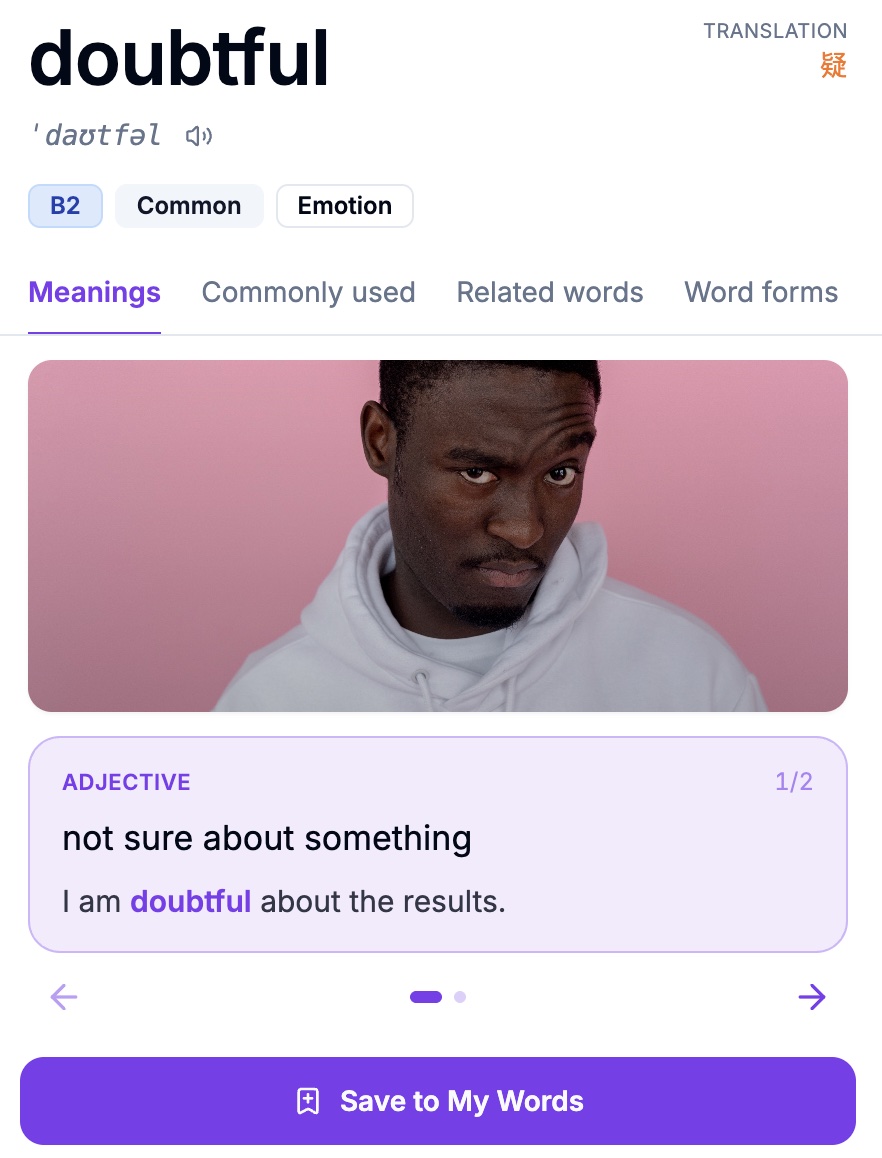
Every word in HighVocab comes with its IPA pronunciation, audio, a clear definition, an example sentence and a translation in your language. That's over 50,000 words.

- Select a word while you readWith the browser extension, select any word on a web page to see its IPA, meaning and example.
- Listen, then read the IPAPress the speaker icon, then look at the symbols and stress mark. Can you see why it sounds that way?
- Say it out loudRepeat the word three times, copying the stress. Compare with the audio.
- Save it and review itSave the word and HighVocab brings it back for review at the right time, using spaced repetition. Each review is another chance to practise the sound.
FAQ
How many sounds does English have?
Standard British English has about 44 sounds: around 24 consonants and 20 vowels, including diphthongs. The exact number depends on the accent.
Why do dictionaries show two pronunciations?
Many dictionaries show both a British (UK) and an American (US) pronunciation. The main differences are the r sound after vowels, and a few vowels such as the o in hot and go.
Do I need to learn every IPA symbol?
No. Most English IPA symbols look like normal letters and sound the way you expect. You only need to learn about a dozen special symbols, such as θ ð ʃ ʒ ŋ æ ʌ ə and the length mark ː.
Hear every word you learn
IPA, audio, meaning and translation for every word you save, and a review schedule so you don't forget them.
Free to start, no credit card.